| Available since TB Version 4.3 |
API keys provide a simpler alternative to password-based authentication for the ThingsBoard API.
Unlike JWT tokens that require login and periodically expire, API keys are long-lived credentials that remain valid until their configured expiration date or until they are manually revoked.
Key features
- No login required: API keys work immediately without exchanging a username and password.
- Long-lived: They stay valid until the expiration date you set.
- Permission inheritance: The key inherits the exact same rights as the user it was created for.
- Easy management: You can enable, disable, or delete a key at any time.
- Simple integration: Perfect for third-party apps where you want to avoid complex authentication code.
Creating API Keys
API keys can be created for your own account or for other platform users, depending on your permissions.
Creating API Key for Your Account
To create an API key for your own account:
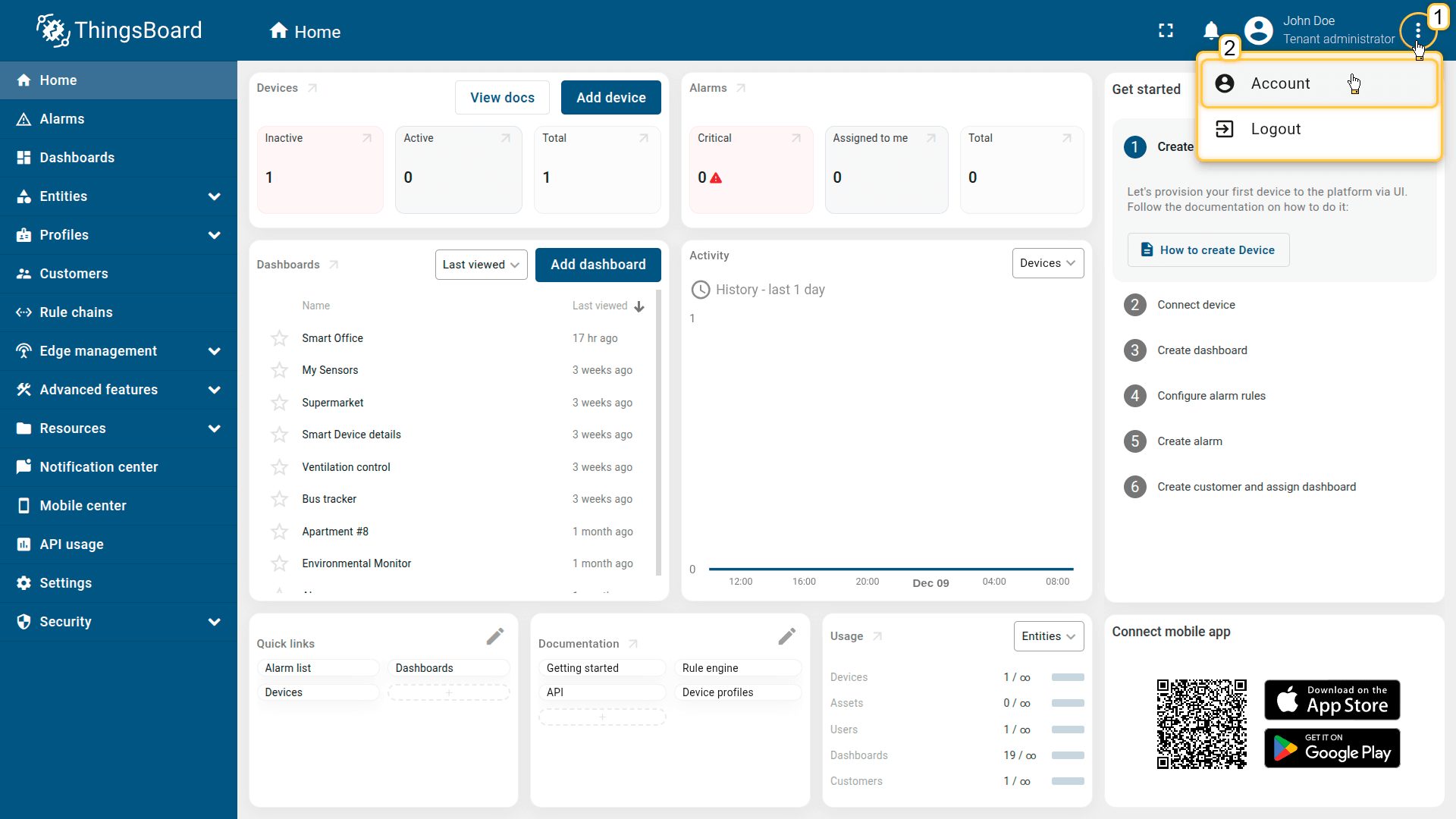
- In the top-right corner, click the three-dot menu and select Account.
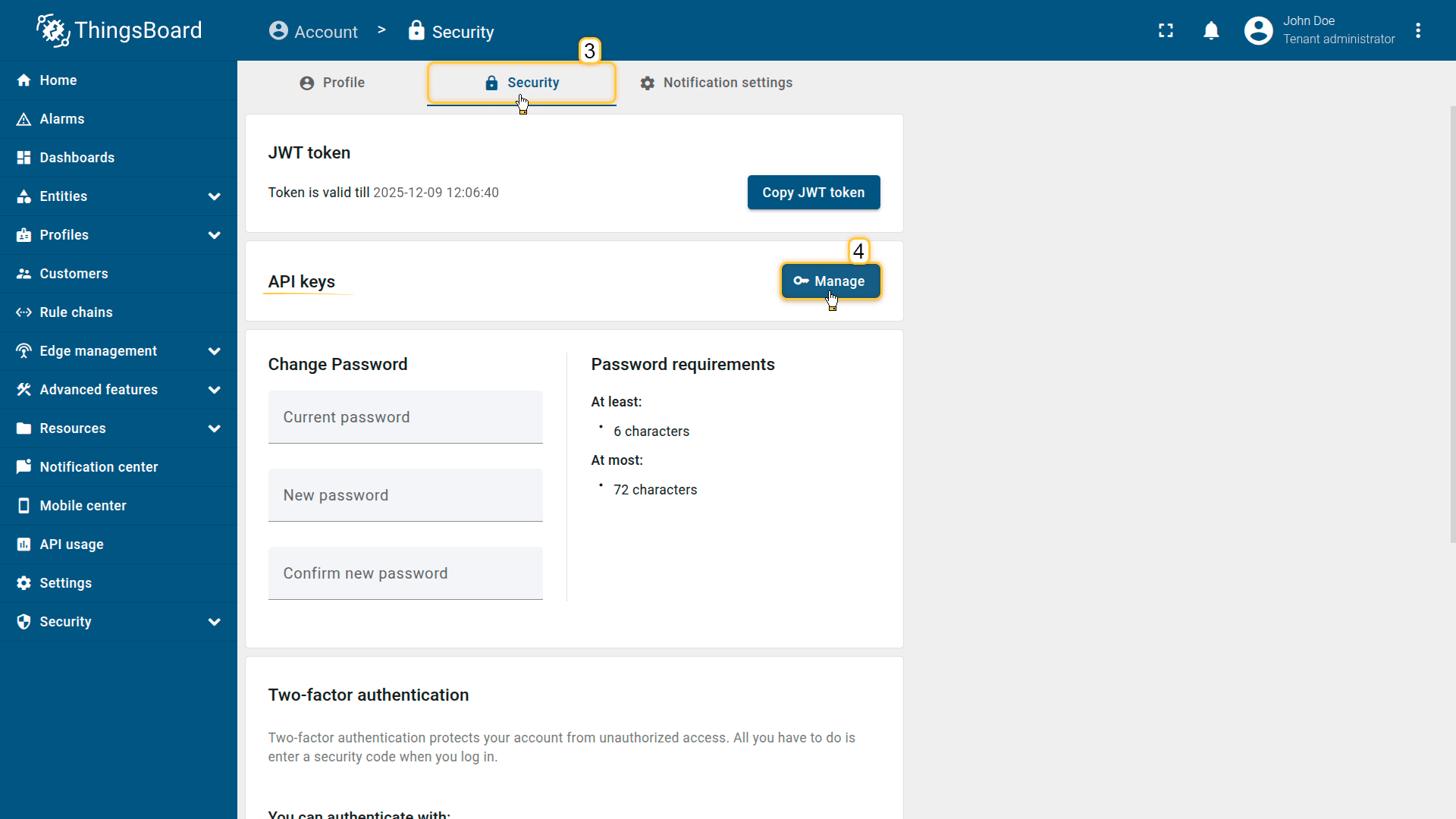
- Navigate to the Security tab.
- In the API keys section, click the Manage button.
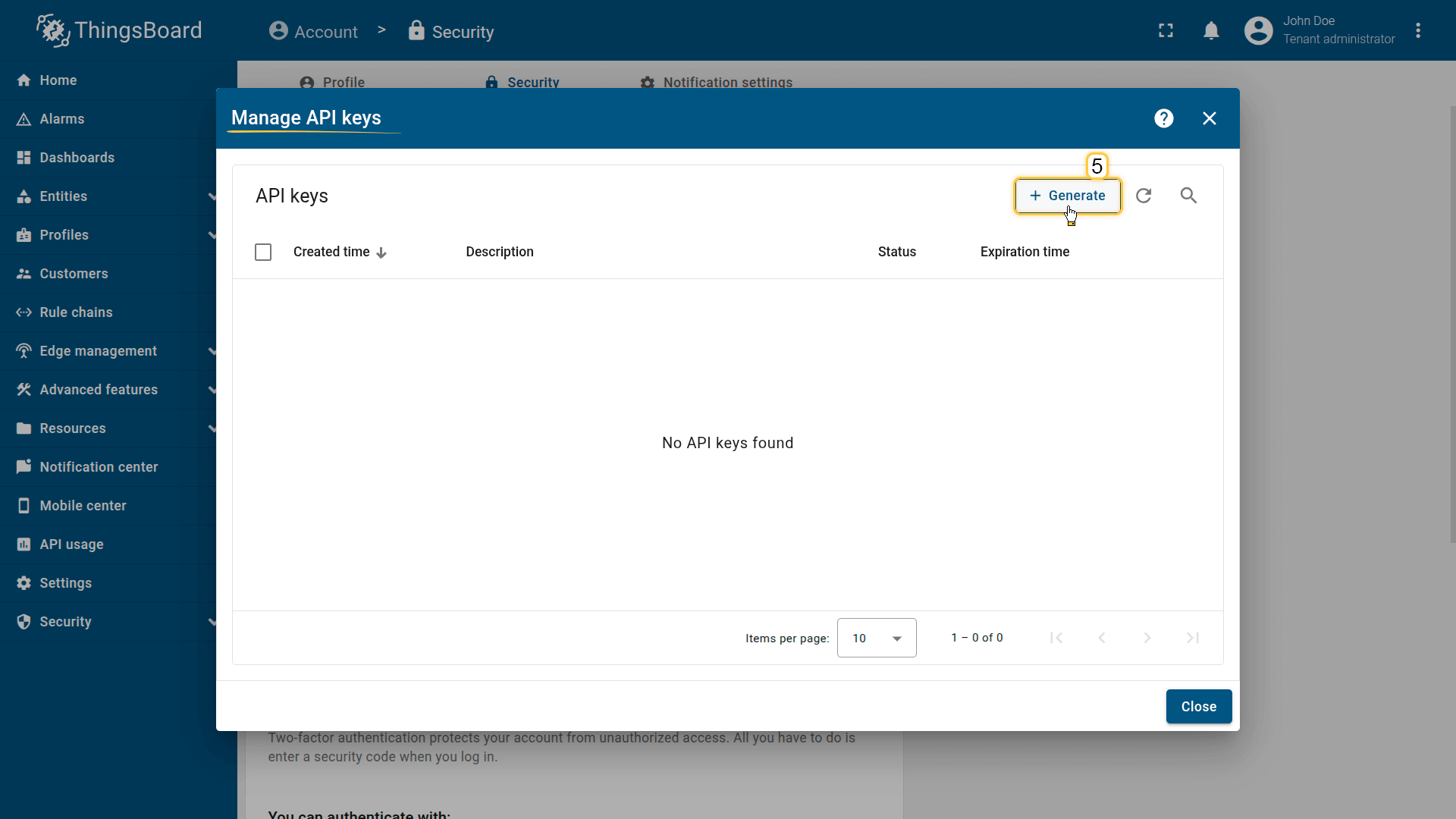
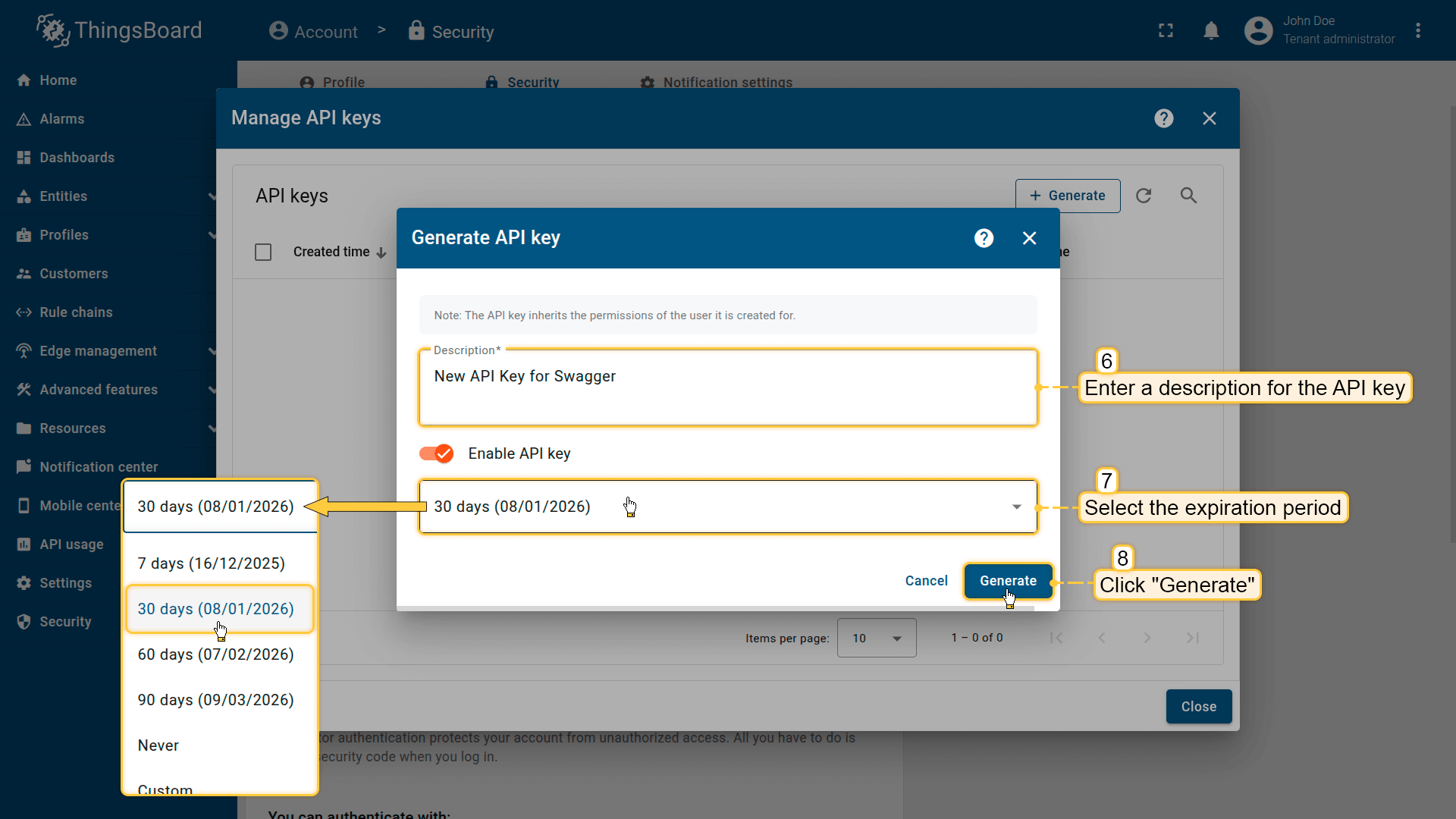
- Click the + Generate button.
- Enter a description for the API key (e.g., Production server, Testing environment).
- Select the expiration period.
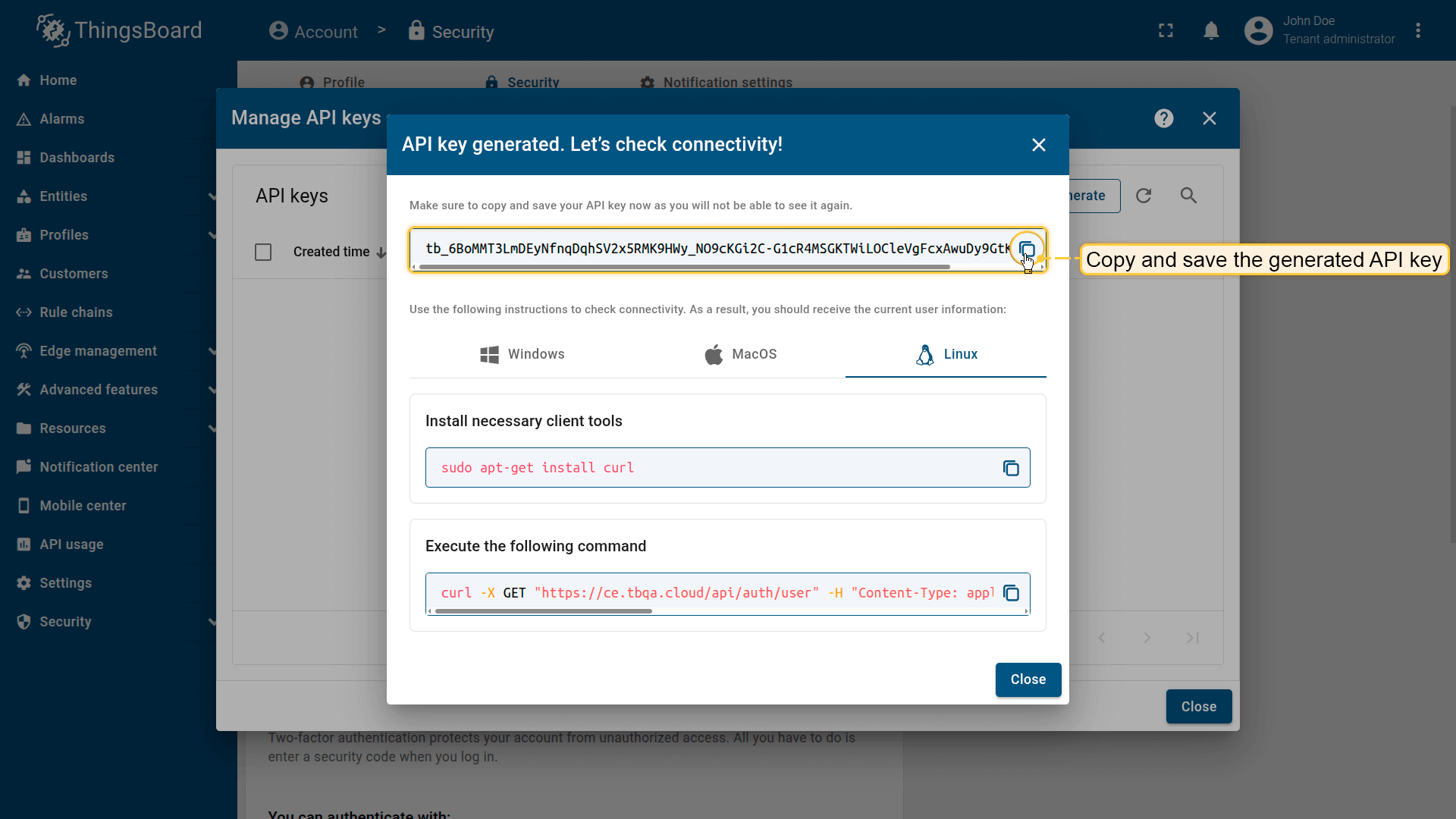
- Click Generate.
Important: Copy and save the generated API key - it will not be displayed again.
Creating API Key for Another User
API keys can also be created directly from the user’s details page. A system administrator can create API keys for any users available to them (tenant users), and a tenant administrator can create API keys for their customer users. In the user details view, the API keys tab provides full access to API key management for that specific user.
- Navigate to the Customers/Users section.
- Click on the desired user to open their details.
- Go to the API keys tab.
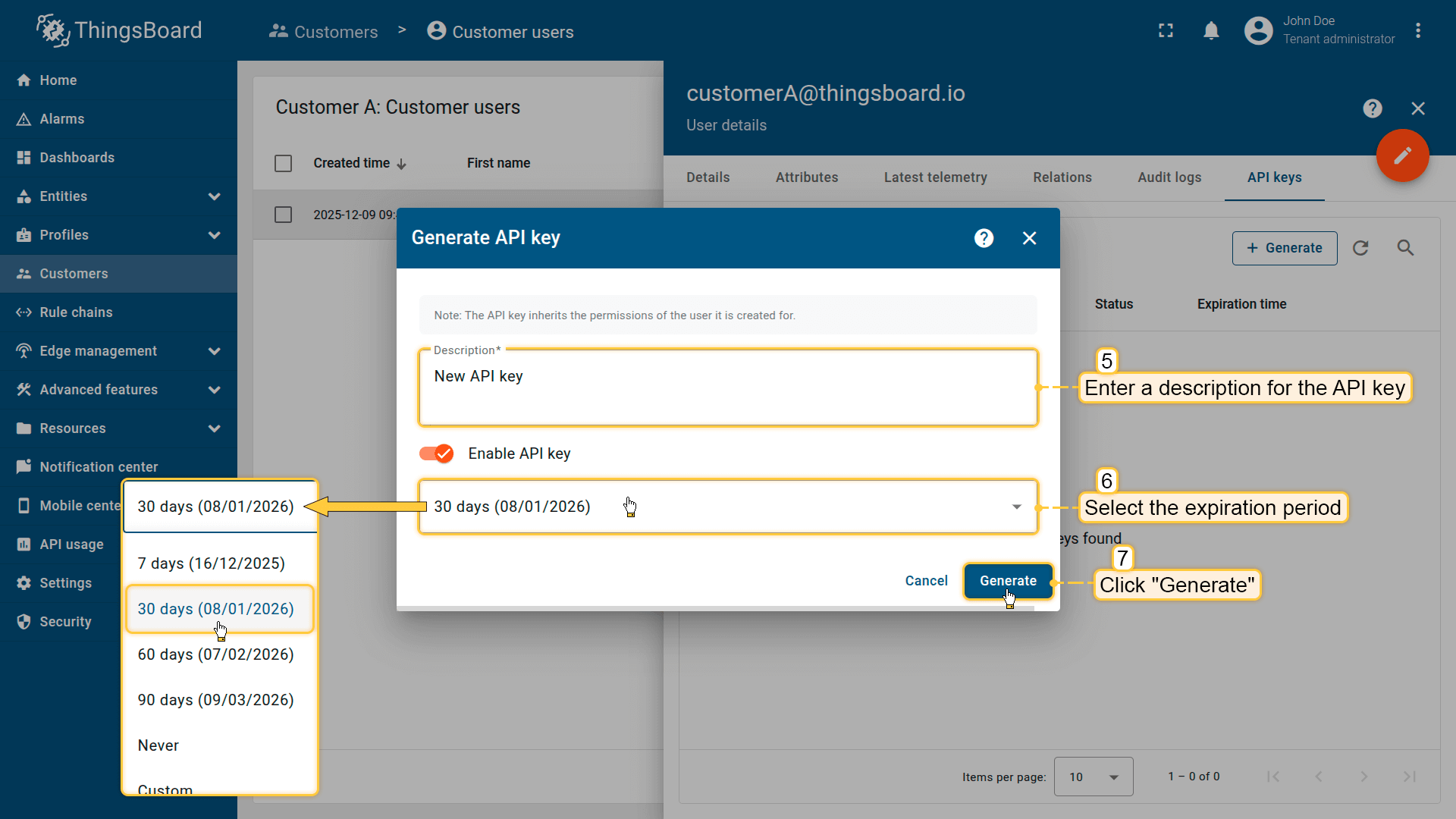
- Click the + Generate button.
- Enter a description for the API key (e.g., Production server, Testing environment).
- Select the expiration period.
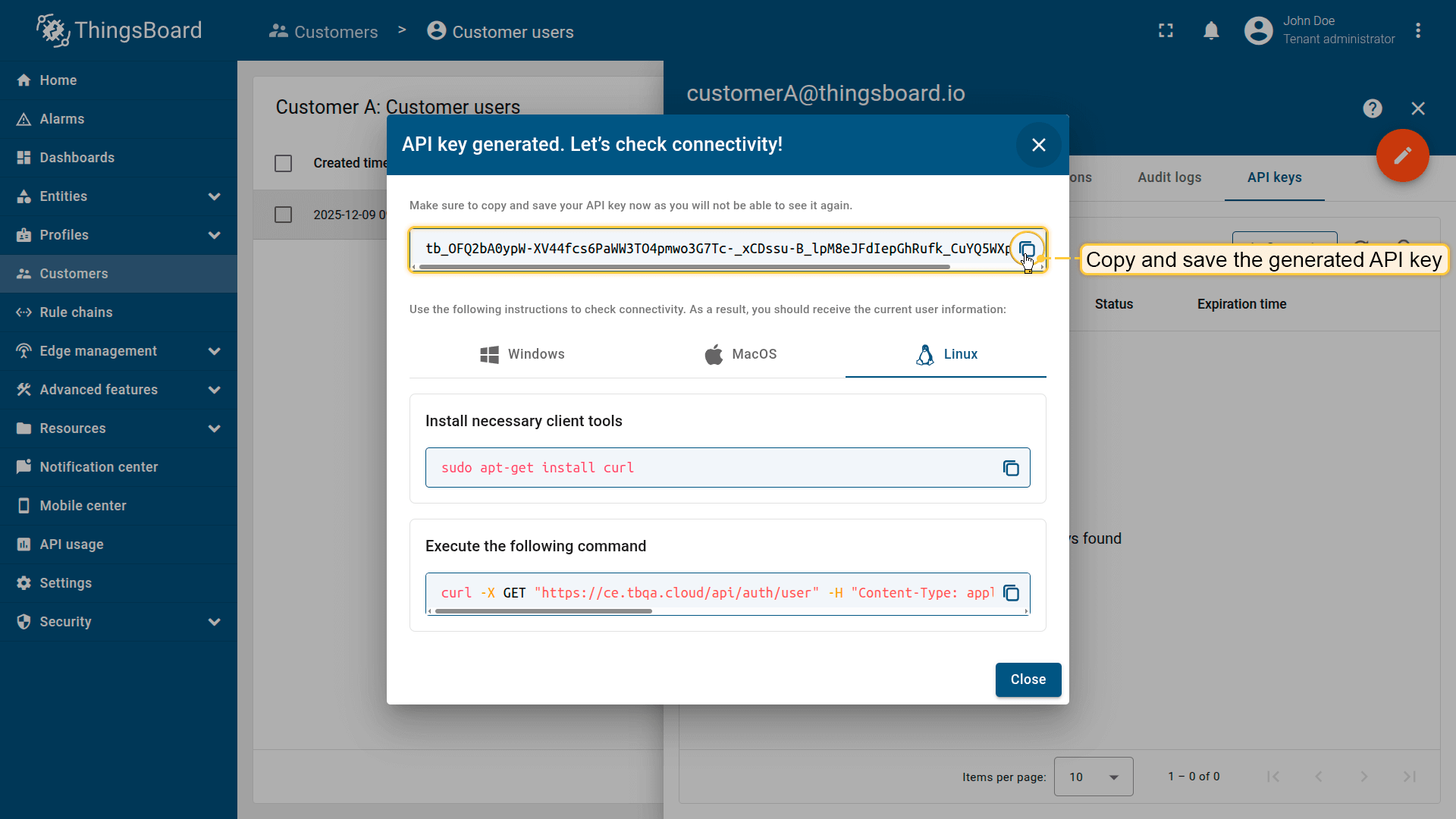
- Click Generate.
Important: Copy and save the generated API key — it will not be displayed again.
Note: The API key inherits all permissions of the user for whom it was created.
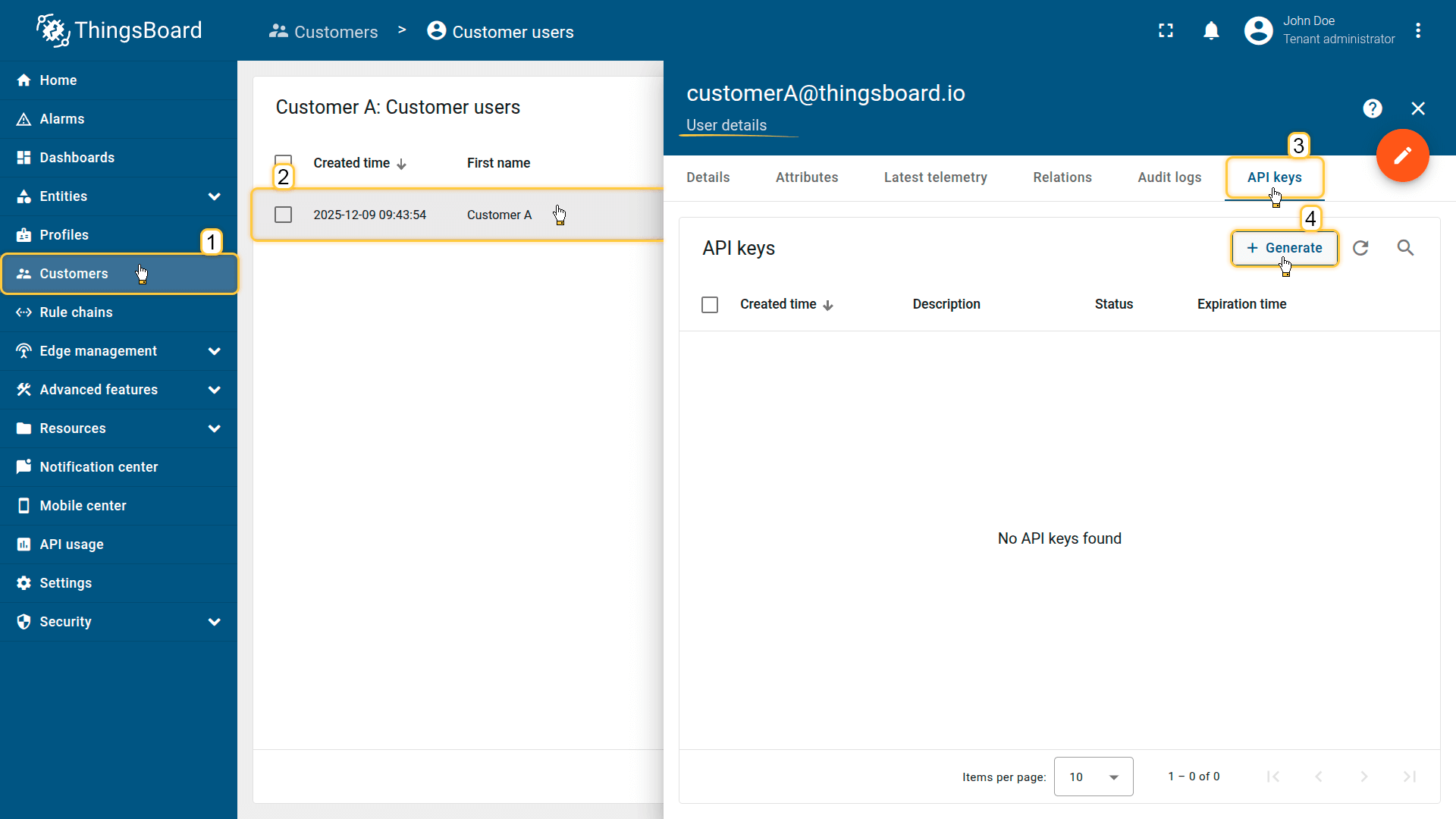
Click on the desired user to open their details.
Navigate to the API keys tab and click the + Generate button.
Using API Keys
In API requests
Include the API key in the X-Authorization header with the ApiKey prefix:
1
X-Authorization: ApiKey $YOUR_API_KEY_VALUE
* Replace $YOUR_API_KEY_VALUE with the API key.
Example:
1
2
3
curl -X GET --header 'Accept: application/json' \
            --header 'X-Authorization: ApiKey tb_4xpayYjwrKCv5n15CvvS6IUb8vVZe55D-aoXcn_-hl9foOCxlEbtWYoy8bhhMqGt' \
            'https://thingsboard.cloud/api/auth/user'

Security note: Always use HTTPS in production environments. Executing commands over insecure HTTP connections will send your API key unencrypted, making it vulnerable to interception.
In Swagger UI
When using Swagger UI, you can authenticate with an API key:
- Open Swagger UI.
- Click the Authorize button.
- In the API key form (apiKey) section, enter your API key value with the ApiKey prefix:
1
ApiKey YOUR_API_KEY_VALUE
- Click Authorize.
Note: If both JWT and API key are authenticated, JWT takes precedence.
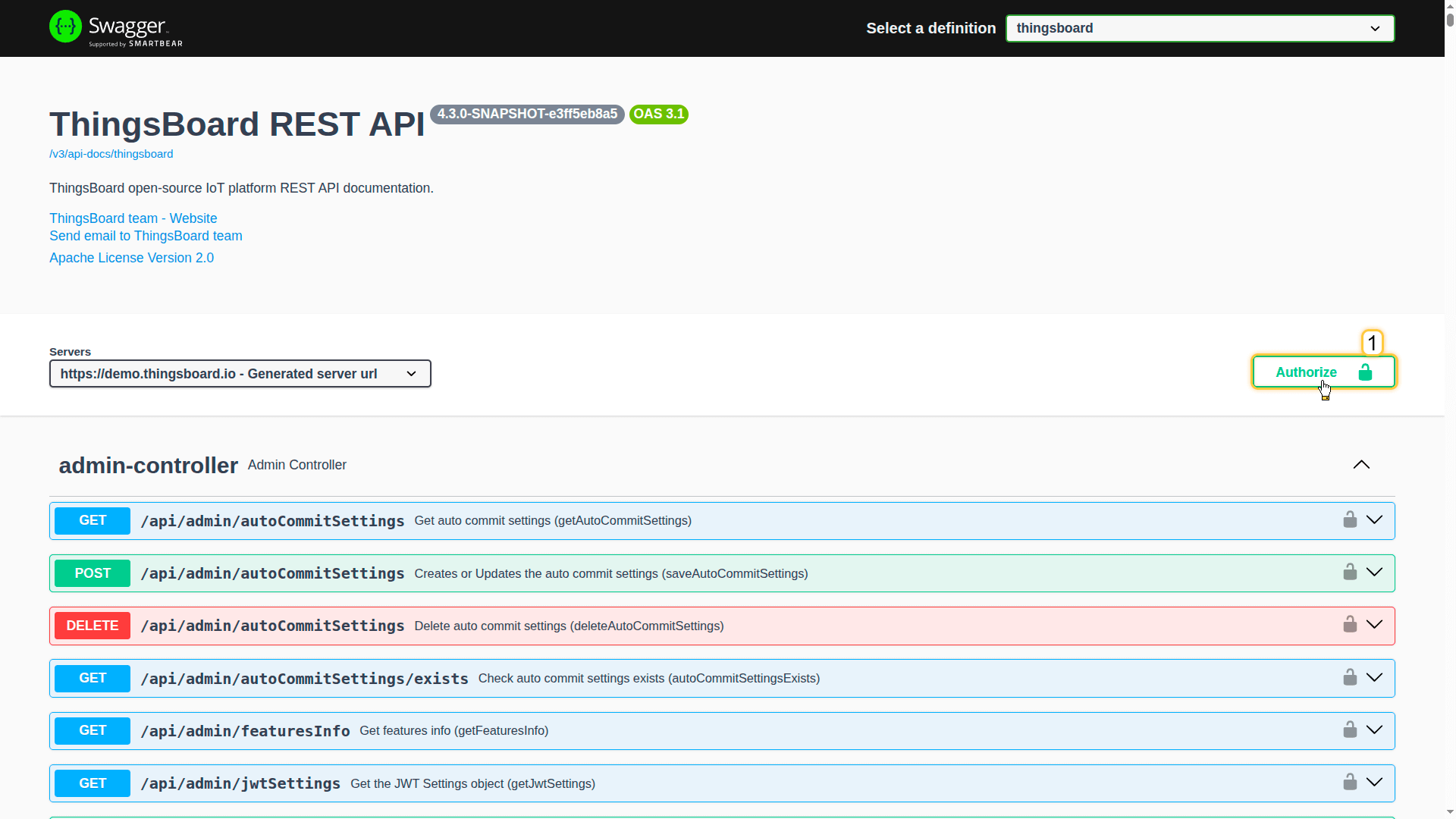
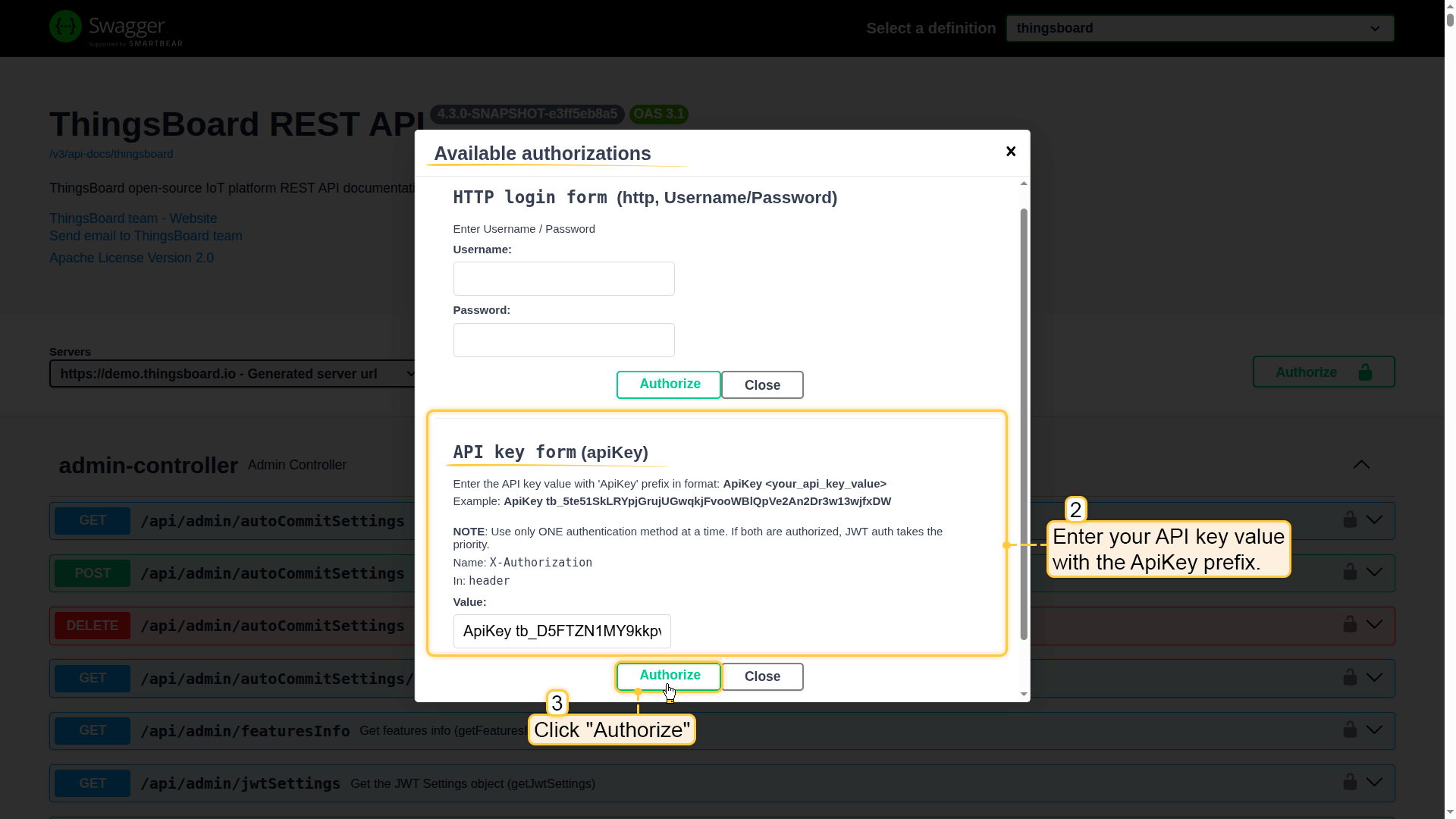
Then, click "Authorize".
Managing API keys
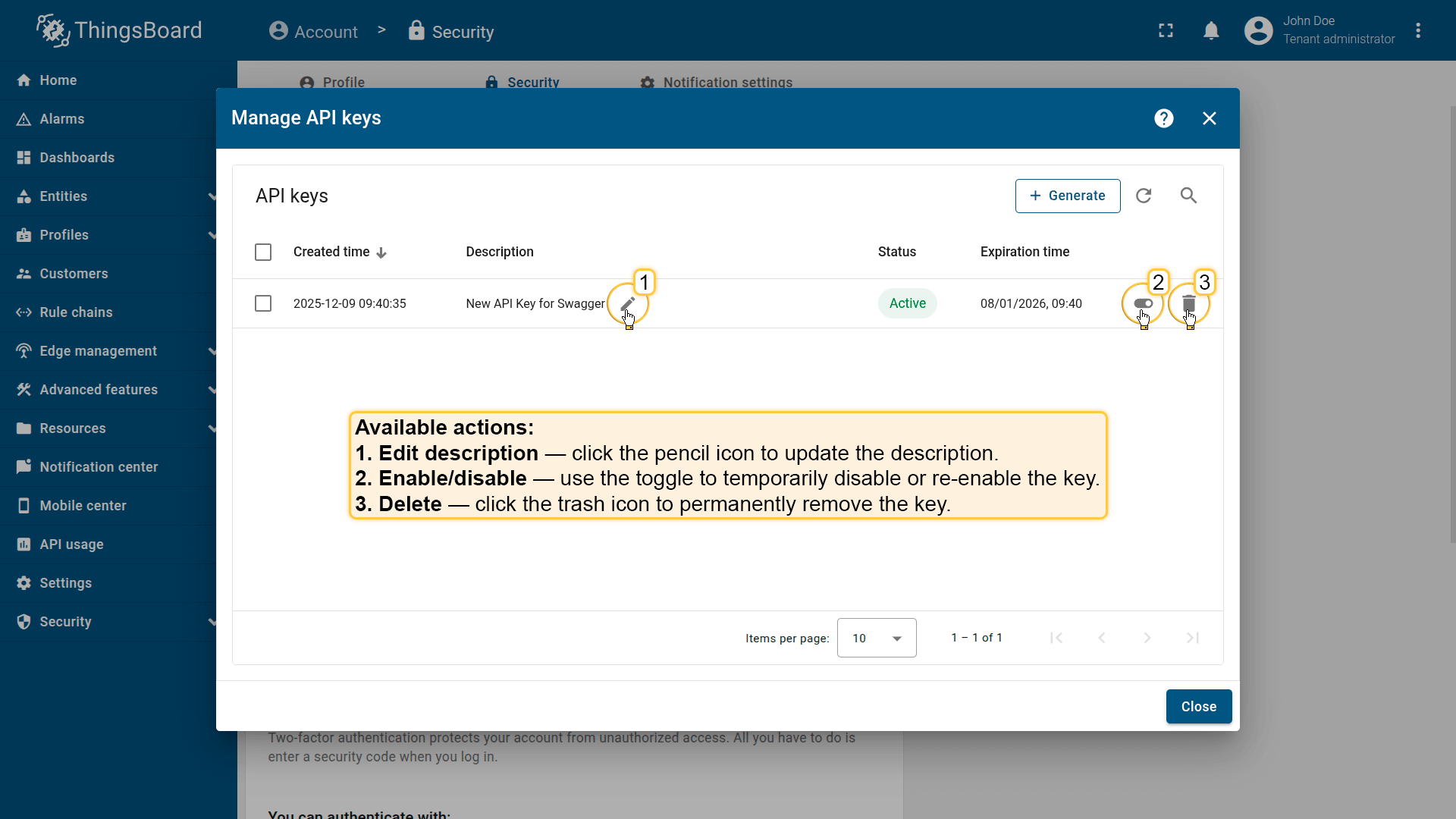
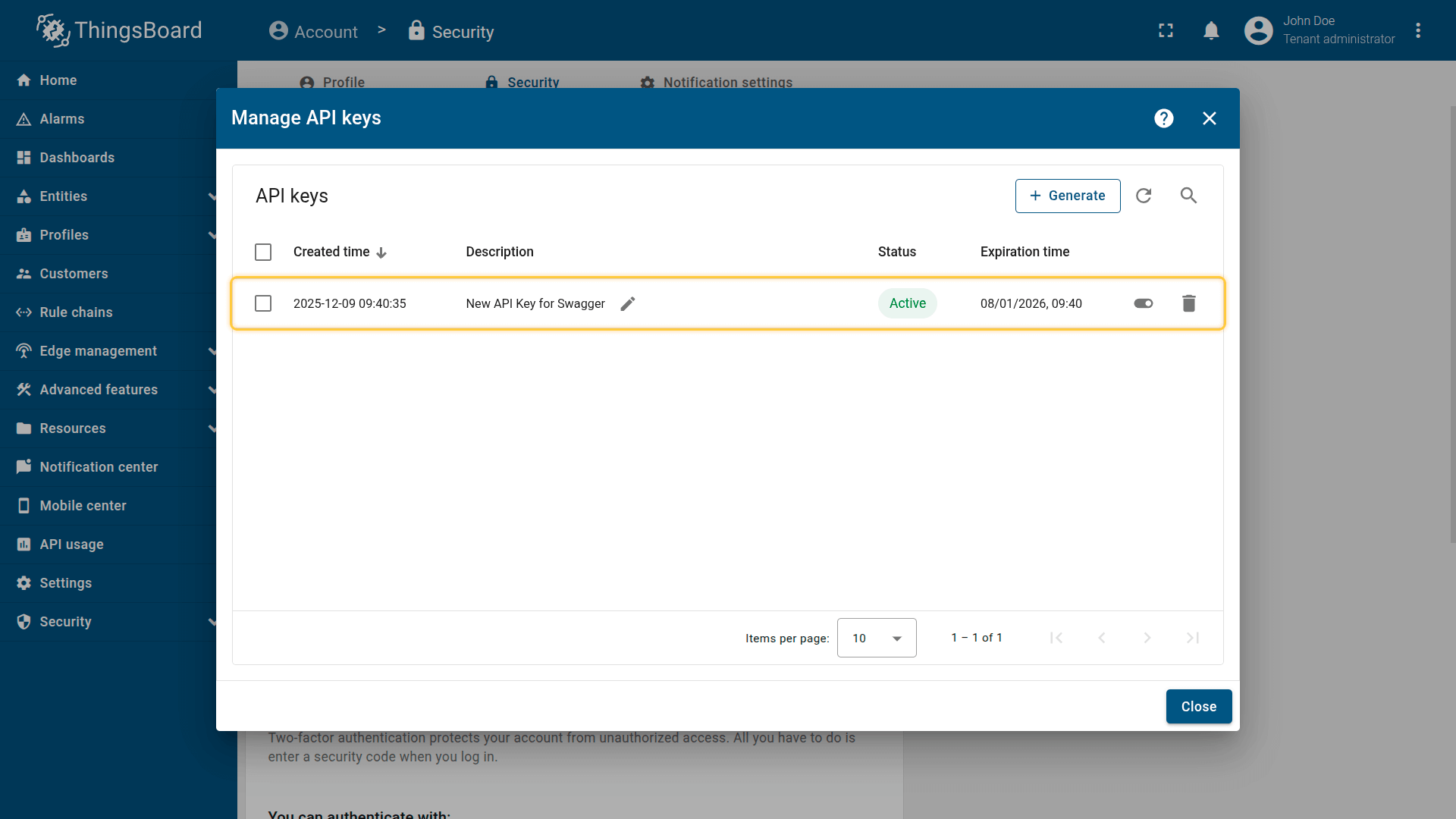
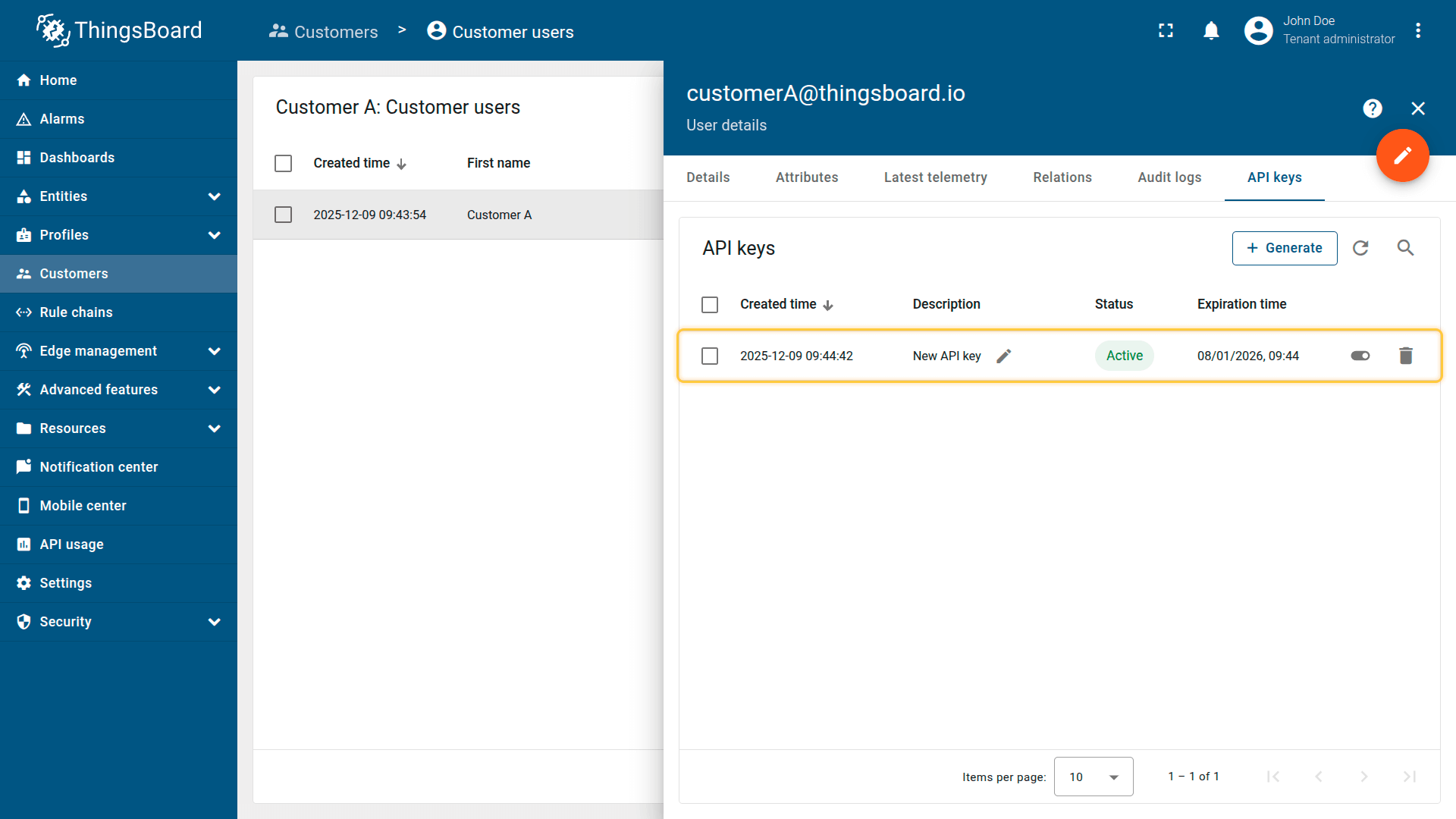
In the API keys table, each key displays the following information:
- Created time: When the API key was generated
- Description: A custom description assigned to the key
- Status: Indicates whether the key is active or disabled
- Expiration time: The date and time when the key will expire
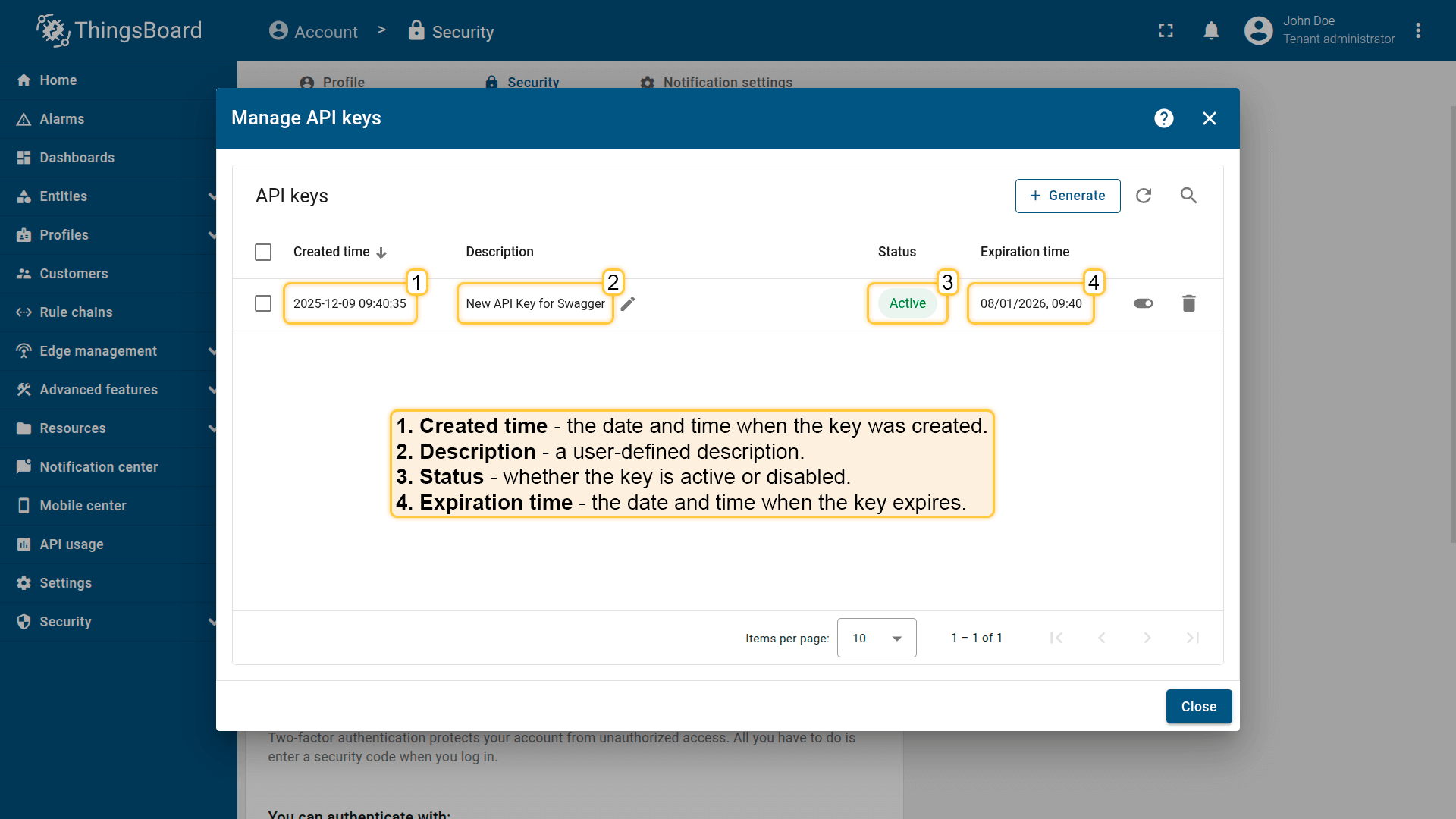
Additionally, the following actions are available for each API key:
- Enable/disable API keys — Use the toggle switch next to each API key to temporarily disable or re-enable it without deleting the key.
- Delete API keys — Click the delete (trash) icon to permanently remove a key. This action cannot be undone.
- Edit description — Click the edit (pencil) icon next to the description to update the API key’s description.